7 best transcript summarizers powered by AI
AI summarization is a powerful tool across industries—from sales to education to business. In this article, we compare seven transcript summarizers across accuracy, features, pricing, and more.




The transition to online communication—from sales calls to internal meetings to educational coursework—has created significant opportunities for new AI-powered tools and platforms that help individuals fully use all this digital data. In fact, industry data shows the use of virtual meetings by businesses increased from 48% to 77% between 2000 and 2022.
One predominant AI feature that has risen in popularity is AI-powered transcript summarizers. In addition to providing an immediate transcript of a virtual meeting or lecture (using AI speech-to-text), AI transcript summarizers can summarize the meeting's main points, call attention to specific conversation areas, or even summarize post-meeting action or follow-up items.
In this article, we compare seven of the best transcript summarizers powered by AI that are available today across features such as accuracy, scalability, language support, API access, and more. We'll explore the business value these tools deliver, industry-specific applications, and practical implementation considerations to help you choose the right solution for your needs.
Why businesses are turning to AI transcript summarizers
Businesses are turning to AI transcript summarizers because manual audio review wastes hundreds of hours annually while missing critical insights. As McKinsey research suggests, generative AI has the potential to automate work activities that currently absorb 60 to 70 percent of employees’ time. Teams processing large volumes of meetings, sales calls, and customer interactions can't scale human note-taking to capture strategic intelligence from every conversation.
AI transcript summarizers solve this by automatically converting speech into text and then distilling it into concise, actionable summaries. This shift isn't just about saving time. It's about unlocking the strategic value of every conversation, enabling faster decision-making, and ensuring no critical detail gets missed.
Companies like CallSource and Clari are already leveraging AI transcript summarization to transform their voice data into strategic assets. Key applications include:
- Customer service teams: Quickly identify recurring issues and improve response strategies, with a 2025 survey finding that 69% of companies saw improved customer service after implementing conversation intelligence.
- Sales organizations: Enable better coaching by analyzing successful call patterns
- Educational institutions: Make learning content more accessible and searchable
The technology addresses several critical pain points: inconsistent manual note-taking across teams, important details lost in lengthy recordings, difficulty sharing insights across departments, and the inability to search through voice content at scale. By automating the summarization process, businesses can redirect human effort toward acting on insights rather than capturing them.
What to look for in an AI transcript summarizer
Before we examine the results in further detail, let's explore the metrics used for comparison.
Category
Transcript summarizers can either be generic or purpose-built to solve a specific problem. The type of summarizer you choose will impact the way in which the summary is generated. For example, some AI summarization models are built and trained on conversational data, like a virtual meeting, while others may be trained on static text inputs instead.
Some summarizers also let you modify how the summary is displayed: a paragraph, bullet points, length, short, keywords, etc. Others tailor their output based on the industry the tool was built for, such as sales, virtual meetings, call coaching, or education.
Accuracy
The accuracy of the AI transcript summarizer will be directly dependent on (a) the accuracy of the transcript used to generate the summary and (b) the accuracy of the AI summarization model used. In fact, in a survey of tech leaders, accuracy was cited as a top-three factor for evaluating AI vendors, alongside cost and overall performance. Make sure to test each provider you are considering with audio/video files that match your intended use case to obtain the most useful results.
Additional features available
Is transcript summarization the only feature you need or are there additional audio or conversation intelligence features you will need as well? Each of the providers discussed here vary greatly in their product offering, so make sure to choose the feature set that best matches your needs.
Pricing
Some platforms contain their transcript summarizer within a bigger package or offering while others offer it as a one-off tool. The size of the platform and the size of the feature package will greatly impact the price, so take time to determine exactly what you need before deciding on a provider. Some providers also offer a free tier based on volume usage.
Platform compatibility
Finally, make sure to check platform compatibility prior to committing to a provider. For example, some platforms require you to supply pre-transcribed audio/video files while others will perform the transcription and summarization near-simultaneously. Other platforms seamlessly integrate into virtual meeting platforms like Zoom or Teams to generate the summary automatically.
Ultimately, your specific use case will be the biggest factor in determining the best AI transcript summarizer for you, so let's examine each of these tools more thoroughly.
Business impact: ROI and productivity gains
AI transcript summarizers deliver measurable productivity gains—teams save 5-8 hours weekly on meeting documentation alone. And some reports show that organizations implementing these tools see 40% faster meeting follow-ups and a 25% improvement in action item completion rates.
Key business impacts include:
- Project management: 25% reduction in project delays through accurate action item capture
- Sales performance: 30% improvement in follow-up effectiveness by identifying customer pain points
- Revenue intelligence: Convert conversation data into searchable strategic assets that drive revenue growth
The compounding effect of these improvements creates substantial organizational value. When every conversation becomes searchable and actionable, teams make better decisions faster. Knowledge that was previously siloed in individual notes becomes organizational intelligence.
Organizations implementing AI transcript summarizers report significant improvements in operational efficiency, with teams able to process and act on vastly more information than was previously possible. The technology transforms voice data from a burden into a competitive advantage.
7 best transcript summarizers powered by AI
Best for summarizing transcripts with keywords
Fireflies.ai

Source: Fireflies.ai
Fireflies.ai is a dedicated AI notetaker that transcribes, summarizes, and analyzes virtual meetings. Its transcripts and summaries are highly accurate, making them extremely useful tools for those interested in obtaining meeting summaries automatically or in using the transcripts for further analysis.
Fireflies.ai can be integrated via a Chrome extension, directly into a virtual meeting platform, or via API, making it compatible with most platforms. Additional features include the ability to share meeting notes directly via a collaboration app like Slack, create soundbites, track speaker talk time, perform sentiment analysis, and automate workflows.
Pricing for Fireflies.ai ranges from a free plan for unlimited transcription but limited AI summaries to $39 per seat per month for enterprise-level use including unlimited AI summarization.
Best for custom summaries
AssemblyAI
AssemblyAI is an industry-leading API for speech-to-text and speech understanding models, built by a team of top Voice AI research experts. The company is constantly shipping new updates and improvements for its numerous Voice AI models, including speech recognition, streaming speech-to-text, summarization, content moderation, sentiment analysis, and more.
AssemblyAI also offers LLM gateway, which lets users leverage advanced LLM capabilities to extract insights automatically from audio and video files. This includes generating highly accurate custom summaries that can be tailored to meet the specific needs of the user and/or company.
Pricing for AssemblyAI's Pay as You Go plan starts at $0.15/hour for our Universal model, with volume discounts available for teams building products at scale.
Interested users can test LLM gateway and custom summaries in the free AI playground.
Best for smart meeting notes
Sembly AI
Source: Sembly AI
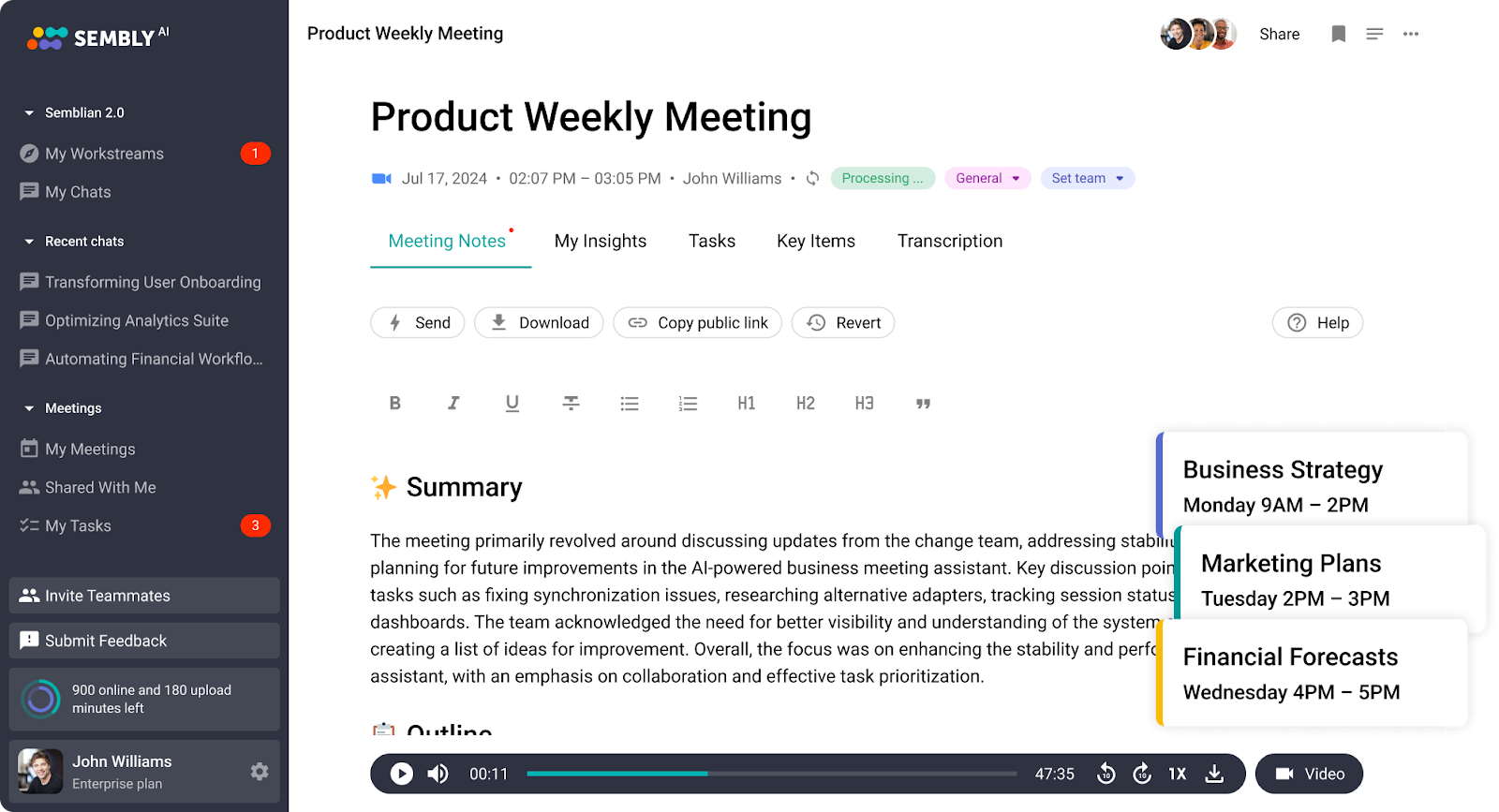
Sembly AI is an AI platform for AI-generated meeting notes, AI tasks, AI artifacts, and AI chat. The AI can be directly integrated into common virtual meeting platforms such as Microsoft Teams, Zoom, and more. Once Sembly is added to the virtual call, the AI will automatically record, transcribe, and provide intelligent insights generated post-call, including AI meeting notes.
The AI meeting notes appear in the same language the meeting was recorded in, and are provided via a shareable summary and time-stamped outline, at high accuracy. Sembly AI also offers a multitude of additional AI-powered features.
Pricing for Sembly AI starts at $0 for up to 60 minutes of meeting time per month and goes up to $20 per seat per month to gain access to all of Sembly AI's features. There is also a custom plan available for enterprise users.
Grain
Source: Grain
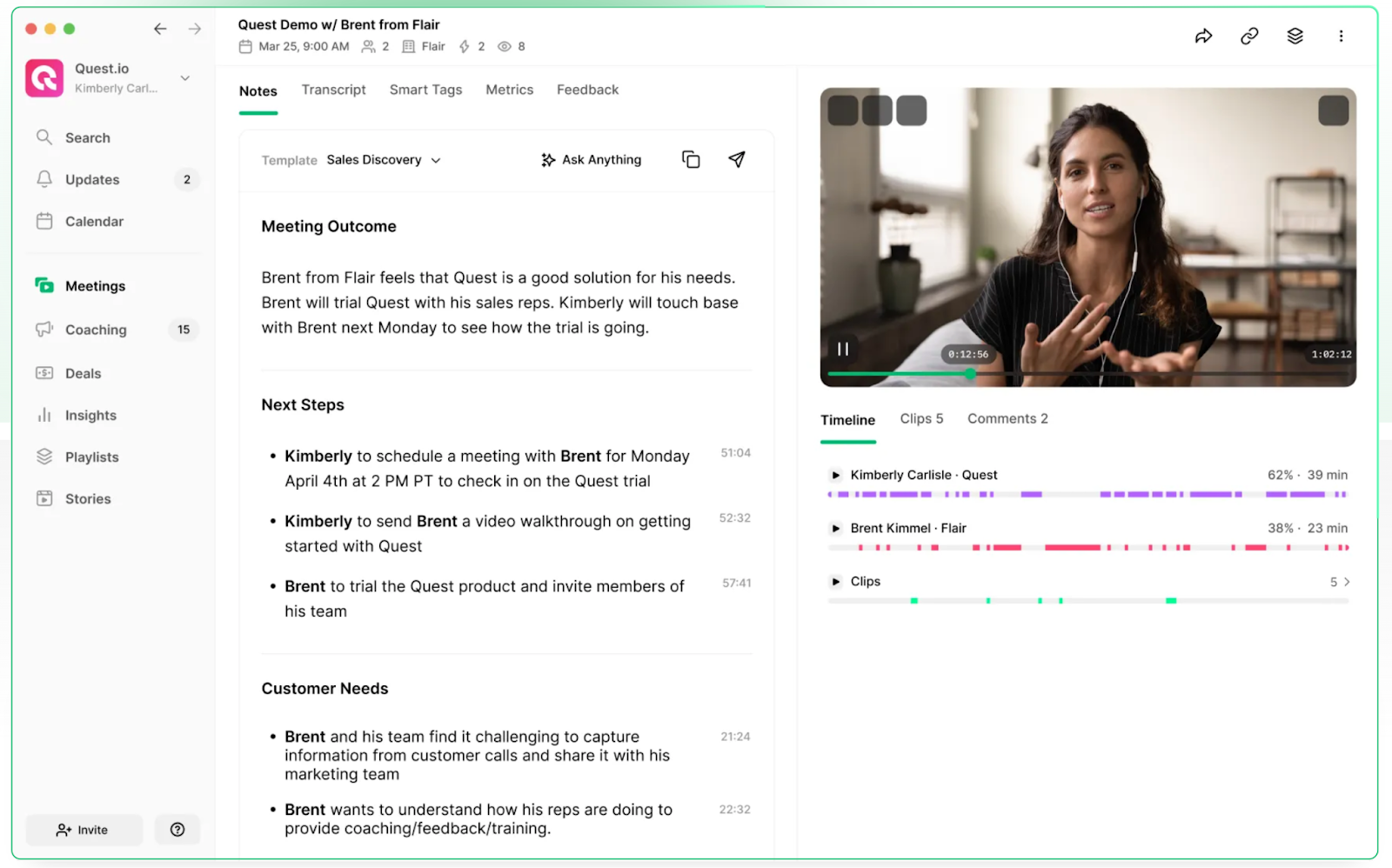
Grain is another highly accurate AI-powered platform that helps automate note-taking and record-keeping and generate AI insights for virtual meetings. Like Sembly AI, Grain can be integrated directly into popular virtual meeting platforms. Grain can also be integrated with CRMs such as HubSpot and Salesforce to automatically update records and data.
In addition to note-taking, Grain also offers AI-powered meeting automation, coaching, collaboration, analytics, and insight tools.
Pricing for Grain begins at $0 for up to 20 meetings and go up to $29 per seat per month for business accounts and access to all of Grain's AI-powered features. Enterprise accounts are also available at request.
Best for one-off summaries
AssemblyAI

Source: AssemblyAI
In addition to its API, AssemblyAI also offers an AI playground where users can directly upload any audio or video file and receive a highly accurate transcript and summary in just a few seconds.
This service is great for one-off transcriptions or summaries or to test the API before committing to higher usage. Users can toggle on/off AssemblyAI's various AI models, including Summarization and Auto Chapters (time-stamped summaries), and use the LLM Gateway to tailor the summary format and output as desired.
Best for sales and call tracking
CallRail

Source: CallRail
CallRail is a call tracking and marketing analytics software with an extensive feature set, including summarization. The CallRail platform lets users record and transcribe all virtual calls and meetings and then perform AI-powered analytics such as conversation intelligence, lead tracking, keyword tracking, and summarization.
Its AI-powered summarization feature provides a highly accurate summary of every call that can be used for quick reference and context-sharing among teams.
CallRail directly integrates with top platforms such as HubSpot, Salesforce, Slack, and Google Analytics. Pricing starts at $55 per month for call tracking and AI and up to $175 per month for use of its complete suite.
Jiminny
Source: Jiminny
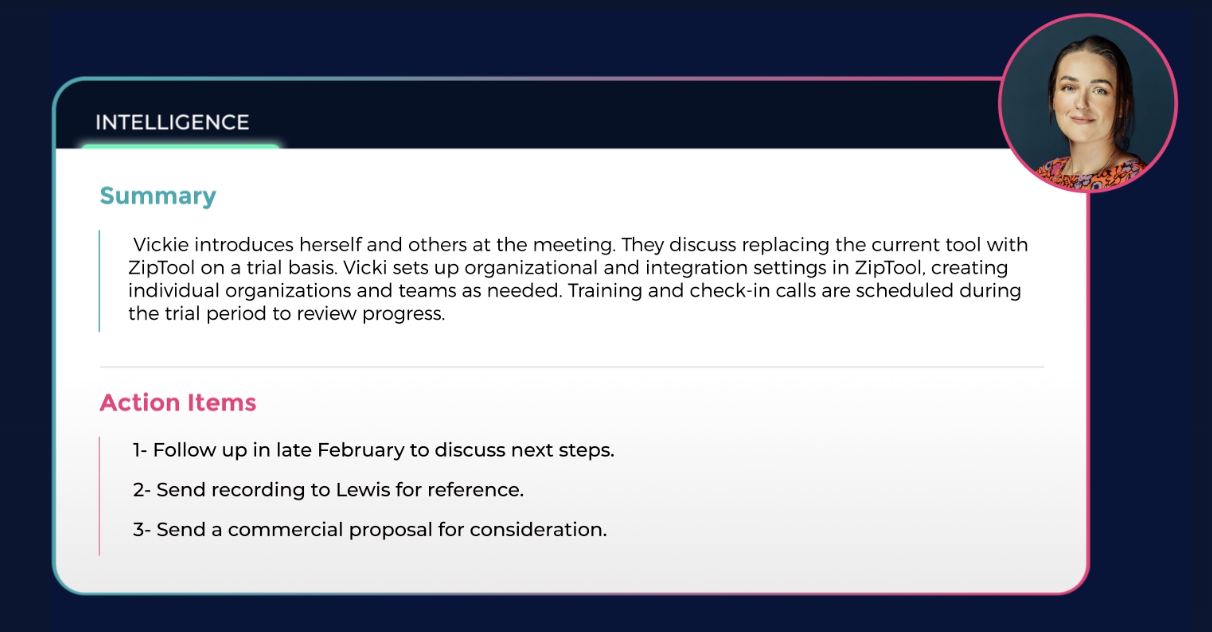
Jiminny is a revenue intelligence platform that uses AI to help teams capture and analyze go-to-market insights. The platform captures all of a user's video, voice, calendar, and email data and auto-logs it into the user's CRM.
Additional features include customer sentiment and behavior analysis, automated call scoring, and deal insights. In addition, summarized meeting notes are automatically provided in bullet points after each call. Jiminny can be integrated into Slack, zoom, Google Meet, Salesforce, HubSpot, and more.
Pricing for Jiminny is available by request.
Industry-specific applications and use cases
While transcript summarization is broadly useful, its impact is most significant in specific industries. In healthcare, companies like PatientNotes.app use summarization to help clinicians quickly generate accurate patient notes, reducing administrative burden. For legal professionals, platforms such as JusticeText leverage summarization to pinpoint critical moments in depositions and evidence files.
In education, students use tools like Jamworks to create study guides from lectures. The key is that the summarization model understands the context and terminology of the specific domain.
Healthcare and medical documentation
Healthcare providers face unique challenges with documentation requirements and compliance standards. AI transcript summarizers designed for medical use must accurately capture clinical terminology, medication names, and treatment protocols. These specialized systems help reduce physician burnout by automating the creation of SOAP notes, discharge summaries, and consultation reports while maintaining HIPAA compliance.
Legal and compliance
Legal professionals use transcript summarization for depositions, court proceedings, and client consultations. The technology must handle legal terminology accurately and maintain chain-of-custody requirements. Law firms report significant time savings in discovery processes and case preparation when implementing these tools.
Sales and revenue intelligence
Sales organizations leverage transcript summarizers to analyze customer conversations at scale. These tools identify successful talk tracks, common objections, and competitive mentions across thousands of calls. Sales managers use the insights for coaching, while revenue operations teams track deal progression and forecast accuracy.
Education and training
Educational institutions and corporate training departments use AI summarization to make learning content more accessible. Students with learning differences benefit from searchable lecture transcripts, while corporate trainers can quickly identify knowledge gaps across training sessions.
Implementation and integration considerations
Adopting an AI summarizer involves more than just choosing a tool. For developers and product teams, the key consideration is API access. A well-documented, flexible API like AssemblyAI's allows you to integrate summarization directly into your own application, giving you full control over the user experience.
For business teams, the focus is on workflow integration. Does the tool connect with your CRM, like Salesforce, or your collaboration platform, like Slack? Consider whether you need a standalone application or a foundational AI model that can be built upon to meet your unique scaling and security requirements.
Technical integration requirements
Successful implementation starts with understanding your technical infrastructure. Cloud-based APIs offer flexibility and scalability, while on-premises solutions may be necessary for highly regulated industries. Consider factors like data residency requirements, processing volume limits, and failover capabilities.
Security and compliance
Data security is paramount when handling sensitive conversations. Underscoring this, a recent survey found that over 30% of product leaders cite data privacy and security as a significant challenge. Look for providers with SOC 2 Type II certification, GDPR compliance, and industry-specific certifications like HIPAA for healthcare. Understand how data is processed, stored, and deleted.
Some organizations require dedicated instances or private cloud deployments.
Change management and adoption
Technology adoption requires careful change management. Start with pilot programs in receptive departments before rolling out organization-wide. Provide clear training on both the technology and new workflows.
Establish metrics to measure adoption and impact, adjusting your approach based on user feedback.
Scaling considerations
Plan for growth from the beginning. Consider how costs scale with usage, whether the platform can handle peak loads, and how you'll manage increasing data volumes. Companies like Whereby and Supernormal have successfully scaled their implementations from startup to enterprise by choosing platforms that grow with their needs.
Choose the right AI transcript summarizer for your business
AI transcript summarizers are extremely valuable tools for those looking to automatically summarize virtual audio and video content at high accuracy. The right choice depends on your specific use case, technical requirements, and business objectives.
Choose your solution based on specific requirements:
- API integration: AssemblyAI for custom applications requiring industry-leading accuracy
- Meeting automation: Fireflies.ai and Sembly AI for automatic capture and team collaboration
- Sales intelligence: Jiminny for revenue teams needing combined summarization and deal insights
Start with pilot programs to validate technology fit before full deployment.
Consider starting with a pilot program to validate the technology fits your workflow. Test multiple providers with real-world audio from your specific use case. Evaluate not just the accuracy of transcription and summarization, but also ease of integration, scalability, and long-term support.
The organizations seeing the most value from AI transcript summarization are those that treat it as a strategic initiative rather than a simple tool implementation. They integrate summarization into core workflows, train teams on best practices, and continuously optimize based on results.
Ready to see how AI transcript summarization can transform your business? Start by testing AssemblyAI's free playground to experience industry-leading accuracy, or try our API for free to begin building custom summarization into your applications.
Frequently asked questions about AI transcript summarizers
What is the difference between a transcript summarizer and a meeting assistant?
A meeting assistant is typically a user-facing application that joins calls, records them, and provides a summary. A transcript summarizer is often a more fundamental AI model, accessible via an API, that developers can use to build summarization features into their own products, offering greater customization and control.
How is the accuracy of an AI summary measured?
Summary accuracy is evaluated by comparing AI-generated summaries against human-written ones, focusing on factual consistency and coverage of key points. The quality of the summary is directly tied to the transcription model's ability to accurately capture the speech in the first place. For detailed performance metrics, we recommend referring to official benchmarks and testing any provider with your actual audio content to validate real-world performance.
Can AI summarizers handle different languages and accents?
Yes, advanced AI models are trained on diverse datasets to handle a wide range of languages, dialects, and accents. The quality of the summary is directly tied to the transcription model's ability to accurately capture the speech in the first place. It's critical to choose a provider that continuously invests in improving its models for global use.
What is the typical ROI for an AI transcript summarizer?
ROI typically ranges from 200-400% within 12 months through productivity gains and strategic insights. Teams save hundreds of hours annually while improving sales effectiveness and decision-making speed.
How long does it take to implement an AI transcript summarizer?
Implementation timelines range from days for simple SaaS solutions to 1-3 months for enterprise deployments with complex security requirements. Custom API integrations typically require several weeks for full implementation and testing.
Lorem ipsum dolor sit amet, consectetur adipiscing elit, sed do eiusmod tempor incididunt ut labore et dolore magna aliqua. Ut enim ad minim veniam, quis nostrud exercitation ullamco laboris nisi ut aliquip ex ea commodo consequat. Duis aute irure dolor in reprehenderit in voluptate velit esse cillum dolore eu fugiat nulla pariatur.
Related posts
%20influence%20automatic%20speaker%20labeling_.png)